Translate

17/11/22

Worth Fighting For


Il PinchukArtCentre in collaborazione con M HKA, ArtAsyl e. V., Rotary Club Köln-Ville, Zilkens Fine Art Insurance Broker ha presentato un'importante mostra collettiva con oltre 45 artisti Worth Fighting For nello spazio temporaneo in Oskar-Jäger-Strasse 97-99, 50933 Colonia. La mostra include il progetto Russian War Crimes presentato dal PinchukArtCentre e dalla Victor Pinchuk Foundation in collaborazione con l'Ufficio del Presidente dell'Ucraina, il Ministero degli Affari Esteri dell'Ucraina, la Coalizione Ucraina 5AM e l'Associazione Ucraina dei Fotografi Professionisti. 

La mostra Worth Fighting For fa parte di una profonda collaborazione tra il PinchukArtCentre, una delle principali istituzioni ucraine di arte contemporanea, e il museo di arte contemporanea di Anversa M HKA per affrontare non solo le urgenze immediate ma anche le sfide strategiche. Il progetto di Colonia sarà aperto al pubblico fino a mercoledì 14 dicembre .
La cerimonia di apertura della mostra è stata introdotta da Berivan Aymaz , Vicepresidente del Parlamento statale del Nord Reno-Westfalia, Gonca Türkeli-Dehnert , Segretario di Stato presso il Ministero della Cultura e della Scienza, Oleksii Makeiev , Ambasciatore ucraino in Germania, Dr. Ralph Elster , sindaco della città di Colonia, Bart De Baere e Björn Geldhof , curatori della mostra.


CS
The PinchukArtCentre (Kyiv, Ukraine) in partnership with M HKA, ArtAsyl e. V., Rotary Club Köln-Ville, Zilkens Fine Art Insurance Broker presented a major group exhibition with over 45 artists Worth Fighting For in the temporary space on Oskar-Jäger-Strasse 97-99, 50933 Koeln. The exhibition includes the Russian War Crimes project presented by the PinchukArtCentre and Victor Pinchuk Foundation in partnership with the Office of the President of Ukraine, Ukraine’s Ministry of Foreign Affairs, Ukraine 5AM Coalition and Ukrainian Association of Professional Photographers. 
The Worth Fighting For exhibition is part of a deep cooperation between the PinchukArtCentre, one of the leading Ukrainian contemporary Art institutions, and the Antwerp contemporary art museum M HKA to address not only immediate urgencies but also strategic challenges. The project in Cologne will be open to the public until Wednesday 14th December.
The opening ceremony of the exhibition was introduced by Berivan Aymaz, Vice President of the State Parliament of North Rhine-Westphalia, Gonca Türkeli-Dehnert, State Secretary in the Ministry of Culture and Science, Oleksii Makeiev, Ukrainian Ambassador to Germany, Dr. Ralph Elster, Mayor of the City of Cologne, Bart De Baere and Björn Geldhof, curators of the exhibition.

Oleksii Makeiev, Ukrainian Ambassador to Germany, said: “The arts must be protected. When these missiles fall from the skies, the arts in Ukraine, these murals on the walls in Kyiv, in Dnipro, these walls should be protected. This battle will end after all”.  

Bart De Baere, co-curator of Worth Fighting For and Director of M KHA, commented: “It has been marvellous to be able to do this, for many reasons but first and foremost because of the sharing of capacity, through the dialogue between the collection of M HKA and art from the incredible art scene today in Ukraine”.  

Björn Geldhof, co-curator of Worth Fighting For and Russian War Crimes and Artistic Director of the PinchukArtCentre, added: “At the beginning of the full scale invasion of Ukraine Vladimir Putin said that Ukrainian culture doesn’t exist, that Ukrainian art by definition doesn’t exist. When it happened the PinchukArtCentre team turned this institution into a place of cultural activism. And we understood together with the Victor Pinchuk Foundation that it was important to start a cultural front. One of the thing that we absolutely have to do is to defend and promote  Ukrainian culture in any country we could”. 

The exhibition Worth Fighting For brings together an international selection of works from the M HKA/the collection of the Flemish Community, because of their emancipatory and empowering nature. They are shown in dialogue with works by Ukrainian artists, mostly produced in times of war. The outcome is a space that invites us to feel, think and reflect beyond the immediate urgencies of war. 

The scars of the First and Second World War are engraved in the Flemish landscape. A symbolic inclusion to the exhibition is therefore the work Flanders Fields (2000), by Berlinde De Bruyckere that references the First World War where Flanders was an essential battlefield. Then too, artists were sketching, writing poems, playing music while stationed in the trenches. It was a way not to lose touch of their humanity, a way to move beyond being an instrument of war. 

The project consists of seven spaces, each with their own angle.

The project opens with the historical space of war. It is immediately followed by the space of World Making, the need to develop a meaningful relation to the world. The next two spaces deal with the notion of the landscape - Ukraine combines vast open horizons with industrial urbanism – and with the everyday life. After that come spaces focused respectively on the individual stance and on the vital power of the collective. The last space is a direct encounter between catastrophe and art, with seven walls, each time a single art work on one side and some images from the Russian War Crimes exhibition on the other.

From the M HKA collection, part of the Collection of the Flemish Community, there are works from Hüseyin Bahri Alptekin (Turkey, 1957-2007), Francis Alÿs (Belgium, 1959), Babi Badalov (Azerbaijan, 1959), Jan Cox (Netherlands + Belgium, 1919-1980), Berlinde De Bruyckere (Belgium, 1964), Jan de Lauré (Belgium, 1978), Marlene Dumas (South Africa, 1953), Jan Fabre (Belgium, 1958), Sheela Gowda (India, 1957),  Hiwa K (Iraq,1975), Barbara Kruger (USA, 1945), Mark Lewis (Canada, 1958), Kerry James Marshall (USA, 1955), Almagul Menlibayeva (Kazakhstan, 1969), Nástio Mosquito (Angola, 1981), Otobong Nkanga (Nigeria, 1974), ORLAN (France, 1947), Wilhelm Sasnal (Poland, 1972), Allan Sekula (USA, 1951-2013), Adrien Tirtiaux (Belgium, 1980), Luc Tuymans (Belgium, 1958).

From Ukraine there are works from among others Oleksandr Burlaka (1982), Oksana Chepelyk (1961), Danylo Galkin (1985), Nikita Kadan (1982), Alevtina Kakhidze (1973), Nikolay Karabinovych (1988), Lesia Khomenko (1980), Kinder Album (1982), Vlada Ralko (1969), Oleksiy Sai (1975), Andriy Sagaidakovskiy (1957), Yevhen Samborsky (1984), Anna Zvyagintseva (1986), the artist duos Daniil Revkovskiy (1993) & Andriy Rachinskiy (1990) and Yarema Malashchuk (1993) & Roman Khimei (1992). Their works are in some cases early pieces, including a 1990s painting by Andriy Sagaidakovsky, depicting in exclusively blacks and greys a Ukrainian landscape with the text “Sometimes man is tired very much and wants to sleep a lot” - a poignant comment on the exhaustion of war. Most works have been created during this war, respond and reflect directly on current contexts. A symbolic example is that of Lesia Khomenko, who has engaged in painting soldiers and volunteers throughout the war. For the exhibition, she showcases a first group composition of soldiers supported by volunteers who formed a community around the army. It exemplifies Ukraine's unshakable unity, a common rally around the purpose of survival.

Web Sites
http://imagineukraine.ensembles.org/ 
https://www.russianwarcrimeshouse.org 

From 17th June to 9th October 2022 the first iteration of the Worth Fighting For took place in the PinchukArtCentre in Kyiv, Ukraine, under the title When Faith Moves Mountains.

There too the Russian War Crimes project was integrated in it. 

Location: Oskar-Jäger-Strasse 97-99, 50933 Koeln (former Automobile Sales Rooms)
Opening Period: November 15 - December 14, 2022
Opening hours: 10 am – 6 pm every day 
Sponsored by anonymous donors, the Victor Pinchuk Foundation, Die Beauftragte der Bundesregierung für Kultur und Medien, Ministerium für Kultur und Wissenschaft des Landes Nordrhein-Westfalen and Kunststiftung NRW 
Organized by the PinchukArtCentre (Kyiv, Ukraine) and M HKA (Antwerp, Belgium)
Curated by Björn Geldhof and Bart De Baere
 

Riciclare l'arte nel tempo alla Fondazione Prada di Milano


 Oggi si apre la mostra  “Recycling Beauty”, curata di Salvatore Settis e Anna Anguissola con Denise La Monica, che durerà fino al 27 febbraio 2023 nella sede della Fondazione Prada a Milano.

“Recycling Beauty”, il cui progetto allestitivo è ideato da Rem Koolhaas/OMA, è un’inedita ricognizione dedicata al tema del riuso di antichità greche e romane in contesti post-antichi, dal Medioevo al Barocco.


La premessa di questa ricerca è la necessità di considerare il classico non solo come un’eredità del passato, ma come un elemento vitale in grado di incidere sul nostro presente e futuro. Attraverso un innovativo approccio interpretativo e una modalità espositiva sperimentale, il patrimonio antico, e in particolare quello greco-romano, diventa, per usare le parole di Settis, “una chiave di accesso alla molteplicità delle culture del mondo contemporaneo”.

Nonostante la sua rilevanza culturale e la sua ampia diffusione, il reimpiego di materiali antichi è stato al centro degli studi archeologici solo di recente. Solo negli ultimi anni è stato approfondito il dato essenziale di questo fenomeno, ovvero la relazione visuale e concettuale fra gli elementi antichi riusati e il contesto post-antico, lontano da quello di origine, in cui sono stati inclusi. “Recycling Beauty”, al contrario, intende focalizzare l’attenzione sul momento in cui il pezzo antico abbandona la propria condizione iniziale o di rovina e viene riattivato, acquistando nuovo senso e valore grazie al gesto del riuso.


Il progetto espositivo, concepito da Rem Koolhaas/OMA con Giulio Margheri, si sviluppa in due edifici della Fondazione, il Podium e la Cisterna, come un percorso di analisi storica, scoperta e immaginazione. Nel Podium un paesaggio di plinti bassi permette di percepire i pezzi esposti come un insieme, mentre le strutture simili a postazioni di lavoro incoraggiano un esame più ravvicinato grazie alla presenza di sedie da ufficio. Nella Cisterna i visitatori incontrano gli oggetti gradualmente, in una sequenza di spazi che facilitano l’osservazione da punti di vista alternativi. Due sale della Cisterna sono dedicate alla statua colossale di Costantino (IV sec. d.C.), una delle opere più importanti della scultura romana tardo-antica. Due monumentali frammenti marmorei, la mano e il piede destro, normalmente esposti nel cortile del Palazzo dei Conservatori a Roma, saranno accostati a una ricostruzione del Colosso in scala 1:1, mai tentata prima, che evidenzia come l’opera sia il risultato della rielaborazione di una più antica statua di culto, probabilmente di Giove. Questo progetto è il risultato di una collaborazione tra i Musei Capitolini, Fondazione Prada e Factum Foundation, la cui supervisione scientifica è stata seguita da Claudio Parisi Presicce, Sovrintendente Capitolino ai Beni Culturali.

Evidenziando l’importanza dei frammenti, del riuso e dell’interpretazione, “Recycling Beauty” contribuisce a considerare il passato come un fenomeno instabile in costante evoluzione. La mostra ospita oltre sessanta opere d’arte altamente rappresentative provenienti da collezioni pubbliche e musei italiani e internazionali come Musée du Louvre di Parigi, Kunsthistorisches Museum di Vienna, Ny Carlsberg Glyptotek di Copenhagen, Musei Capitolini, Musei Vaticani e Galleria Borghese di Roma, Gallerie degli Uffizi di Firenze e Museo Archeologico Nazionale di Napoli.


16/11/22

Nuovi spazi per la Fondazione Elpis


Foto: Nicolò Panzeri

 A Milano, sta riscuotendo molto successo, l'aperta in un’ex lavanderia, in via Orti 25 a Milano, nel cuore di Porta Romana, degli spazi della Fondazione Elpis.

Si tratta di una serie di stanze, su tre piani, di quasi 900 metri quadrati, ristrutturato e che ora apre con la mostra del collettivo HH Art Spaces

Foto Noemi Ardesi


CS

Diretta da Bruno Barsanti, la Fondazione Elpis è una realtà dinamica, aperta all’internazionalità e al multiculturalismo, un centro di sperimentazione che vede nel supporto ai giovani artisti e talenti emergenti uno dei punti cardine della propria mission.

E così sarà la nuova sede: un luogo dedicato a mostre e installazioni site specific, performance, incontri, reading e attività interdisciplinari pensati per coinvolgere le diverse fasce di pubblico, promuovere visioni inedite e supportare talenti emergenti della scena contemporanea più fresca, provenienti da culture e Paesi diversi.

Foto Noemi Ardesi

A inaugurare i nuovi spazi espositivi di Fondazione Elpis via Orti 25 a Milano è la mostra collettiva 'HAZE. Contemporary Art From South Asia', a cura di HH Art Spaces e Mario D’Souza, aperta al pubblico fino al 5 marzo 2023.

Progetto ambizioso, pensato appositamente per gli spazi della Fondazione, HAZE vuole offrire uno sguardo inedito sull’arte contemporanea dell’Asia meridionale. Attraverso pittura, scultura, disegno, fotografia, performance e installazioni site specific, la mostra presenta le molteplici espressioni del panorama artistico indiano intrecciando pratiche consolidate ed emergenti di 21 artisti di diverse generazioni attivi tra India, Pakistan, Bangladesh e Sri Lanka.
La mostra riunisce le opere di: Bani Abidi, Nikhil Chopra, Avian D'Souza, Madhu Das, Kedar Dhondu, Pranay Dutta, Madhavi Gore, Shivani Gupta, Yasmin Jahan Nupur, Munir Kabani, Romain Loustau, Sahil Naik, Soumitrimayee Paital, Amol Patil, Pala Pothupitiye, Fazal Rizvi, Joydeb Roaja, Lala Rukh, Vineha Sharma, Divyesh Undaviya, Diptej Vernekar.
La mostra è aperta dal giovedì alla domenica  dalle 12.00 alle 19.00.


Foto Noemi Ardesi

Mostra inaugurale:
HAZE. Contemporary Art From South Asia
a cura di HH Art Spaces e Mario D’Souza
Dal 29 ottobre 2022 al 5 marzo 2023
Dal giovedì alla domenica dalle 12.00 alle 19.00

15/11/22

Italian Council 2022/2024


Nei giorni scorsi è stato reso pubblico l'elenco dei vincitori della valutazione di Italian Council per il triennio 2022-2024. Compongono la giuria De Chirico, Direttore del Servizio II – Arte contemporanea che la presiede su delega del Direttore Generale; da Claudio Varagnoli, architetto e professore ordinario all’Università di Chieti e Pescara, Presidente del Comitato tecnico-scientifico per l’arte e l’architettura contemporanee; da Antonia Alampi, storica dell’arte, critica e curatrice, direttrice della Spore Initiative Foundation di Berlino; da Alfredo Cramerotti, critico, curatore e artista, direttore della Mostyn Gallery di Llandudno (Galles); da Roberta Tenconi, curatrice della Fondazione Pirelli HangarBicocca di Milano.


>> VINCITORI AMBITO 1 – COMMITTENZA INTERNAZIONALE E ACQUISIZIONE DI NUOVE OPERE PER I MUSEI PUBBLICI ITALIANI


Sono 12 i vincitori dei finanziamenti per i progetti culturali legati alla committenza di nuove opere di artisti italiani o attivi in Italia per l’acquisizione di musei pubblici italiani e relativa promozione internazionale dell’undicesima edizione di Italian Council, a fronte di 24 candidature pervenute. I progetti selezionati dalla Commissione sono i seguenti:


Radio Papesse (Firenze) con TIMESPAN (Helmsdale, UK), per il progetto Life Chronicles Of Dorothea Ïesj S.P.U. del collettivo ALMARE, destinato al Museion di Bolzano

Associazione per la Gamec (Bergamo) con Kunsthaus Baselland (Muttenz, Svizzera), per il progetto Desertors (Disertori) di Chiara Bersani, destinato all GAMeC di Bergamo

Lo schermo dell’arte (Firenze) con Talbot Rice Gallery (Edimburgo, Scozia, UK), per il progetto La montagna magica (The Magic Mountain) di Micol Roubini, destinato al MAN Museo d’Arte della Provincia di Nuoro

Archive Kabinett (Berlino, Germania), per il progetto Bologna St.173, Un viaggio a ritroso di Muna Mussie, destinato a MAMbo di Bologna

Fondazione smART – Polo per L’arte con Aksioma – Institute for Contemporary Art (Ljubljana, Slovenia), per il progetto Second Order Reality di Carola Bonfili, destinato al MAXXI di Roma

MAMbo – Museo d’Arte Moderna di Bologna con IVAM – Institut Valencià d’Art Modern (València, Spagna) e De Appel Amsterdam (Amsterdam, Olanda), per il progetto Monowe Series di Ludovica Carbotta, destinato al Castello di Rivoli – Museo di Arte Contemporanea (TO)

Orto Botanico di Roma, Dipartimento di Biologia Ambientale, Sapienza Università di Roma (Roma) con Eötvös Loránd University Botanical Garden (Budapest, Ungheria) per il progetto Avant que nature meure di Silvia Cini, destinato all’Istituto Centrale per la Grafica a Roma

Careof (Milano) con Le Cube (Rabat, Marocco), per il progetto Mater Frioul di Fatima Bianchi, destinato al MART di Rovereto

Fondazione ICA (Milano) con SODA-School of Digital Art, Manchester Metropolitan University (Manchester, UK), per il progetto 20/20.000Hz del duo Masbedo, destinato a Museo del Novecento di Milano

Associazione Culturale Palazzo Monti ETS con The Byrd Hoffman Water Mill Foundation (Water Mill, NY, USA) per il progetto Ghostwriting Paul Thek. Time Capsules and Reliquaries di Alessandro Di Pietro, destinato al Madre di Napoli

Tiroler Landesmuseen (Innsbruck, Austria), per il progetto Anna Scalfi Eghenter – SEWV di Anna Scalfi Eghenter, destinato al Museo di Palazzo Collicola di Spoleto

ZEIT (Cagliari) con Museo MAN (Nuoro), Arts Centre Viernulvier (Ghent, Belgio), Teatro di Sardegna (Cagliari) e Flux Factory (New York, USA), per il progetto The Last Lamentation di Valentina Medda, destinato al MAMbo di Bologna

Decreto Direttoriale n. 418 del 27.10.2022

IC 11 – Graduatoria definitiva Ambito 1 – Sezione I

IC 11 – Verbale n. 1 del 24.10.2022


>> VINCITORI AMBITO 2 – PROMOZIONE INTERNAZIONALE DI ARTISTI, CURATORI E CRITICI ITALIANI

Sono 16 i vincitori dei finanziamenti per i progetti culturali legati alla promozione internazionale di artisti, curatori e critici della undicesima edizione di Italian Council, a fronte di 38 candidature pervenute: 4 mostre monografiche all’estero, 1 partecipazioni a eventi internazionali per artisti italiani o residenti in Italia e 11 pubblicazioni internazionali. I progetti selezionati dalla Commissione sono i seguenti:

I progetti selezionati dalla Commissione sono i seguenti:


MOSTRE MONOGRAFICHE IN ISTITUZIONI STRANIERE

Mimosa House, Londra (UK), per la mostra Ab Ovo di Adelaide Cioni, a cura di Ilaria Puri Purini

Ruber.contemporanea con Nitsch Museum, Vienna (Austria), per la mostra Andrea Cusumano. Raumdramaturgie, a cura di Fabio Cavallucci e Giulia Ingarao

BPS22 Musée D’Art de la Province de Hainaut, Charleroi (Belgio), per la mostra Glory VI – Arsenal di Pietro Fontana

Associação Zé Dos Bois – ZDB, Lisbona (Portogallo), per la mostra Pablo Echaurren and the Counterculture in Italy (working title) a cura di Natxo Checa e Sara De Chiara


PARTECIPAZIONI A MANIFESTAZIONI INTERNAZIONALI

Liverpool Biennial of Contemporary Art (UK), per la partecipazione di Binta Diaw alla Biennale di Liverpool 2023 con il progetto Chorus of Soil


PUBBLICAZIONI INTERNAZIONALI

Fondazione Ermenegildo Zegna (Trivero, Biella) per il volume Visible: Seen Through Art. From Artwork to Policies and Care a cura di Martina Angelotti, Matteo Lucchetti, Judith Wielander, NERO

O’ Associazione non profit (Milano) per il volume Italian Zines 1978—2008 a cura di Dafne Boggeri, Les presses du reél (Digione)

Villa Romana (Firenze) per il volume MANIFESTIAMO The Transformative Energies of an Artists’ House in Florence, a cura di Angelika Stepken, Distanz Verlag (Berlino)

Fondazione Torino Musei | GAM Galleria Civica d’Arte Moderna e Contemporanea di Torino per il volume CHIARA CAMONI. Serpentesse (working title), a cura di Elena Volpato, A+Mbookstore Edizioni

Alma Mater Studiorum – Università di Bologna per il volume Skank Bloc Bologna: Alternative Art Spaces Since 1977 a cura di Roberto Pinto, Francesco Spampinato, Mousse Publishing

Lungomare ETS (Bolzano) per il volume Lungomare reader (working title), a cura di Angelika Burtscher e Daniele Lupo, Spector Books (Lipsia)

Associazione ON (Bologna) per il volume Il non detto di Fiamma Montezemolo, NERO

Centre Art Contemporain Genève (Ginevra, Svizzera) per il volume Daily Dense Dance Desiderio (DDDD) di Riccardo Benassi, Andrea Bellini, Kate Crawford, Motto Books (Genève/Berlin/Lausanne)

Bibliotheca Hertziana, Istituto Max Planck per la Storia dell’arte (Roma) per il volume Now we have seen. Women and Art in the Seventies in Italy, a cura di Giorgia Gastaldon, Silvana Editoriale

Viaindustriae (Foligno) per il volume E IL TOPO. (Storia di una rivista d’artista con un’insolita strategia editoriale), a cura di Gabriele Di Matteo e Franco Silvestro, A+Mbookstore Edizioni

Villa Arson (Nizza, Francia) per il volume Le Futur derrière nous. L’art italien depuis les années 1990. Le contemporain face au passé, a cura di Marco Scotini, Silvana Editoriale

14/11/22

I disegni di Louise Bourgeois da Hauser & Wirth a Londra


E' una delle mie artisti preferite e questa bella mostra da Hauser & Wirth alla Somerset sui suoi disegni mette in risalto al sua articolata trasformazione artistica in un ampio lasso di tempo. 


CS

Louise Bourgeois is one of the most important and influential artists of the 20th Century. ‘Drawing Intimacy 1939 – 2010’ shares with the viewer an extraordinary grouping of works from the artist’s private collection.

Exhibited publicly for the first time, the paintings, sculptures and works on paper reflect Bourgeois’s multiplicity of mind and material. Her exploration of self lives within the dreamscape of touch and expression shared in this exhibition. Embodiment as transient sublimation.

‘Louise Bourgeois. Drawing Intimacy 1939 – 2010’ forms a collection of highly personal memories and ideas that in turn reflect the complexity and intimacy of Bourgeois’s practice. The works presented span the breadth of the artist’s oeuvre, from a selection of plaster sculptures to previously unseen paintings, drawings and works on paper. Most of the works on paper were made during the last four years of Bourgeois’s life, and often feature words or phrases which evoke associations and memories. The interaction of image and text crystallizes the interplay of past and present.

The exhibition is curated by Benjamin Shiff, who played a major role in the re-emergence of printmaking in Louise Bourgeois’s practice in the late 1980s, and who remained an important force in her creative use of the medium up until her last years. Unfolding across two galleries in Somerset, ‘Drawing Intimacy 1939 – 2010’ highlights the sensitivity and strength of Bourgeois’s artistic vision: ‘It is not an image I am seeking. It is not an idea. It is an emotion you want to recreate, an emotion of wanting, of giving and of destroying.’

This autumn, ‘Louise Bourgeois. Paintings’ traveled from The Metropolitan Museum of Art, New York to the New Orleans Museum of Art, showing until 1 January 2023. ‘The Woven Child’, previously on view at The Hayward Gallery, London, runs at the Gropius Bau, Berlin until 23 October 2022.


About the artist
Born in France in 1911, and working in America from 1938 until her death in 2010, Louise Bourgeois’s work is inextricably entwined with her life and experiences. For over seven decades, Bourgeois’s creative process was fuelled by an introspective reality, often rooted in cathartic re-visitations of early childhood trauma and frank examinations of female sexuality. Articulated by recurrent motifs (including body parts, houses and spiders), personal symbolism and psychological release, the conceptual and stylistic complexity of Bourgeois’s oeuvre – employing a variety of genres, media and materials – plays upon the powers of association, memory, fantasy and fear

13/11/22

Carol Bove a Parigi da David Zwirner


La sede di Parigi della galleria David Zwirner ospita la recente produzione scultorea di Carol Bove, una serie di lavoro dall'impronta plastica ed estetica


CS

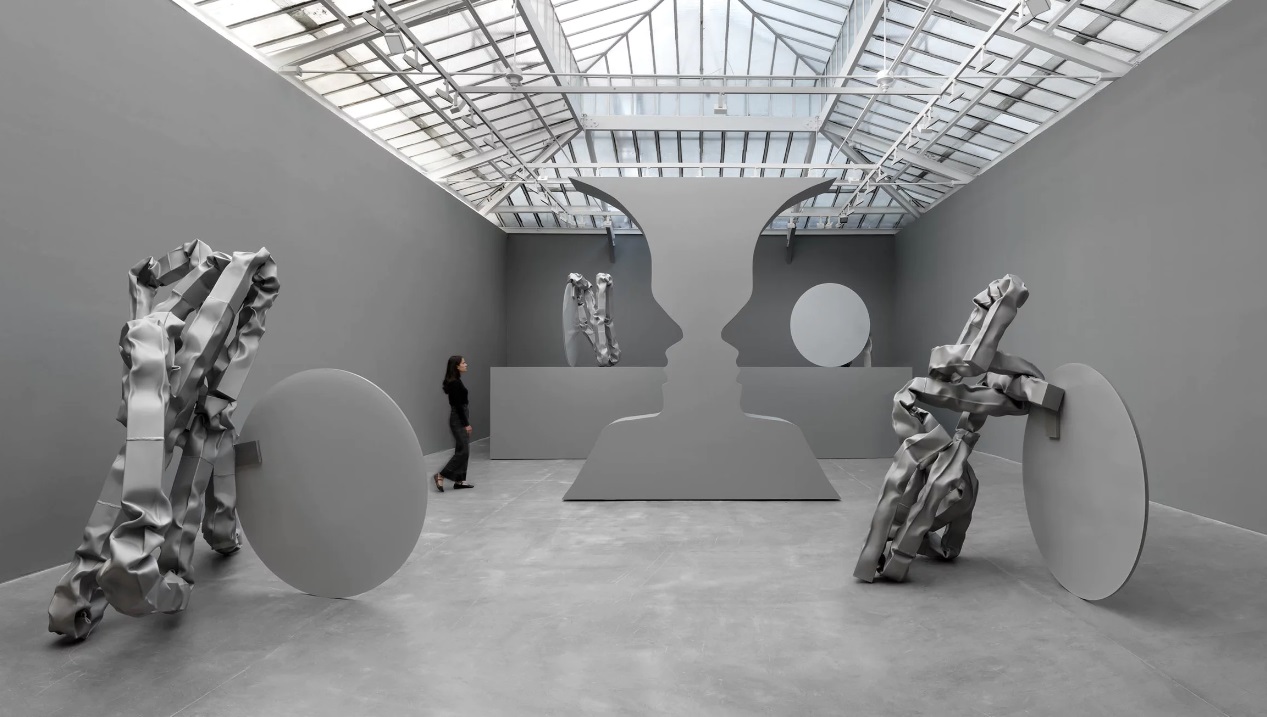
David Zwirner is pleased to present an exhibition of new steel sculptures by Carol Bove at the gallery’s Paris location. Featuring sandblasted stainless steel sculptures and wall-mounted works in painted color, the presentation follows the artist’s acclaimed 2021 exhibitions at the Nasher Sculpture Center, Dallas, and The Metropolitan Museum of Art, New York, and will be Bove’s first solo show in Paris since her Prix Lafayette presentation at Palais de Tokyo in 2010. 

On view in the main gallery space will be large-scale sculptures made of crumpled stainless steel tubing, each combined with a large, circular glass disk. Presented in a monochrome environment, the  installation considers the phenomenological experience of form and the surrounding spatial context. Installed at different elevations and surrounded by gray flooring and walls, the sculptures feature unpainted, contorted and folded steel tubing that has been sandblasted to create a uniformly smooth, almost claylike finish. This matte surface attests to the works’ physical presence as unadorned steel, while also producing an illusionistic effect, as if painted. Combined with large reflective disks–made with glass, thereby echoing the nineteenth-century glass and wrought iron skylight of the gallery space above—that reflect the surrounding space at different angles, Bove’s sculptures simultaneously take in and intervene with their environment, eliding disappearance and disruption. 

The installation includes a three-dimensional construction of a “Rubin’s vase,” the well-known optical illusion first developed in the early twentieth century by the Danish psychologist Edgar Rubin. The image can be read as either two opposing faces, or a vase—their shared boundary results in an unstable reversal of figure and ground. This ambiguous perceptual relationship relates to the paradoxes and ellisions at play in the overall installation between positive and negative space, and the apprehension of form versus gestalt. 

The adjacent galleries will feature an installation of wall-mounted sculptures in colorful matte finishes that paradoxically render the steel tubing as if it were effortlessly malleable. The walls have been covered in a gray-mauve linen that offsets the bright pink, yellow, and orange hues of the sculptures. The vibrating colors of their contorted, folded steel surfaces alternately seem to reference those found on contemporary industrial products, and the luminous, hyperreal pinks, yellows, and faded mauves of late nineteenth-century paintings by artists such as Paul Gauguin and Pierre Bonnard, while their forms simultaneously register to the eye almost like digitally rendered, Photoshopped images. The oscillating associations of distinct historically and technologically bounded references is further emphasized by the relationship between the works’ physical status as sculptures and their connections to painting in their representational evocation of brushstrokes and their technical experimentation with applied color, light, and shadow. 

These sculptures moreover operate on inverse registers of display, chroma, and scale to the installation in the main gallery, further speaking to the physical and perceptual dualities, contradictions, and slippages at play in the overall exhibition. Together, the works on view further Bove’s engagement with the limits of physicality and perception, and attest to the artist’s ongoing exploration of the possibilities of abstract sculpture.

Born in 1971 in Geneva, Carol Bove was raised in Berkeley, California, and studied at New York University. Between 2009 and 2013, she was a clinical associate professor of studio art in Steinhardt’s Department of Art and Art Professions at NYU. The artist joined David Zwirner in 2011. In 2015, The Plastic Unit marked her first solo exhibition at the gallery’s London location, which was followed in 2016 by Polka Dots, her first solo show with the gallery in New York. The artist’s third solo exhibition at the gallery was presented in London in 2018. Her 2019 Hong Kong exhibition Ten Hours was the artist’s fourth solo presentation with the gallery and her first in Asia. In 2021, two concurrent exhibitions, titled Chimes at Midnight and Carol Bove, were on view at the gallery’s West 20th Street and 69th Street locations in New York.

 Also in 2021, four works by the artist were installed in the façade niches of The Metropolitan Museum of Art. Titled Carol Bove: The séances aren’t helping, it was the second in a new series of site-specific commissions for the museum. From 2021 to 2022, two of Bove’s sculptures, The Bicycle (2016) and Will’s Dog (2017), were on long-term view at the Whitney Museum of American Art, New York. The Nasher Sculpture Center in Dallas presented Carol Bove: Collage Sculptures in 2021.

Bove’s work was on view in 2019 alongside John Chamberlain’s in a two-person presentation at the San Francisco Museum of Modern Art. Also in 2019, the artist was invited to participate in the 58th Venice Biennale, which featured a focused selection of recent work. In 2014, The Henry Moore Institute, Leeds, with Museion, Bolzano, Italy, and Museum Dhondt-Dhaenens, Deurle, Belgium, organized an exhibition with Carol Bove and Carlo Scarpa. Venues that have hosted significant solo exhibitions include The Museum of Modern Art, New York (2013); The Common Guild, Glasgow (2013); Palais de Tokyo, Paris (2010); Tate St Ives, England (2009); Blanton Museum of Art, The University of Texas at Austin (2006); Kunsthalle Zürich (2004); and the Institute of Contemporary Art, Boston (2004). The artist’s first major museum presentation was held at Kunstverein Hamburg in 2003. Group exhibitions featuring Bove’s work include the 58th Venice Biennale (2019); the 57th Venice Biennale (2017); documenta 13, Kassel, Germany (2012); the 54th Venice Biennale (2011); and the Whitney Biennial, Whitney Museum of American Art, New York (2008). 

The artist’s large-scale sculptures are often exhibited outdoors and in public spaces. In 2020, four of Bove’s works were installed on the Claremont McKenna College campus in Claremont, California. At the 2018 edition of Unlimited at Art Basel, Bove debuted a monumental sculpture. In 2017, the artist’s sculptures were installed in the Betty and Edward Marcus Sculpture Park at Laguna Gloria, The Contemporary Austin. That same year, her work was on view in Women of Venice at the Swiss Pavilion at the 57th Venice Biennale, where she was invited to respond to the legacy of Swiss artist Alberto Giacometti. Bove’s steel-beam sculpture Lingam (2015) was installed in City Hall Park in New York as part of the 2016 group exhibition The Language of Things, organized by Public Art Fund. In 2013, she created a series of sculptures for the High Line at the Rail Yards in New York.

Work by the artist is represented in permanent collections worldwide, including the Crystal Bridges Museum of American Art, Bentonville, Arkansas; FRAC Grand Large - Hauts-de-France, Dunkirk, France; Institute of Contemporary Art, Boston; The Museum of Modern Art, New York; Princeton University Art Museum, New Jersey; San Francisco Museum of Modern Art; Wadsworth Atheneum Museum of Art, Hartford, Connecticut; Whitney Museum of American Art, New York; and the Yale University Art Gallery, New Haven, Connecticut. She lives and works in New York City.


12/11/22

Giulio Paolini alla Librairie di Marian Goodman a Parigi


Molto interessante la mostra che la Librairie di Marian Goodman di Parigi dedica alla produzione delle edizioni limitate di Giulio Paolini. 


CS
Librairie Marian Goodman is pleased to present an exhibition devoted to Giulio Paolini’s early printed editions and multiples, focusing on the first ten years of production from 1967 to 1977. Paolini, who has just been awarded this year’s Japanese Praemium Imperiale International Arts Award in Painting, is also taking part in the group exhibition Renverser ses Yeux at Jeu de Paume and at Le Bal in Paris from 11 October 2022 to 29 January 2023.

The artist’s limited editions, which he began in 1967, include approximately 150 works. Since his first works in the early 1960s, Paolini has oriented his practice towards a conceptual dimension, drawing attention to the elements that make up the painting, the space of the representation, the relationship between the work and the viewer, as well as to the figure of the author. Over the course of time, the artist’s oeuvre has led him to include the ‘act of the exhibition’ and the artist’s studio as the space where the work comes into being. Paolini’s frame of reference is the classical tradition of beauty and the metaphysical dimension of art, far removed from the evolution of the world and of life as we know it.


Comprising a predominantly consistent range of materials (photographs, plaster cast, drawing paper, Plexiglas, objects, graphics and books), Paolini’s works dialogue with Time and History. Each possesses a complex structure that references art history or literature, forming a coherent and polysemous whole composed of a set of fragments. It is through our attentive observation of each detail that we can gain a reading of the complete composition, exceeding our initial perception of the work itself.

The exhibition presents 13 works including printed editions, artist’s books and multiples, personally selected by the artist. The ensemble highlights how the conceptual research developed by Paolini in the sixties and seventies is brilliantly mapped out and summarized in the editions; in some instances, they were realized in parallel with paintings, sculptures or collages bearing the same title.

Born in Genoa, Italy, in 1940, Giulio Paolini lives and works in Turin. He made his first “painting,” Disegno geometrico, in 1960 and had his first solo exhibition in Italy in 1964. In the mid-1960s, he became associated with the Italian artists of the Arte Povera movement and took part in numerous group shows. He has also had solo shows in major international institutions such as the Castello di Rivoli Museo d’Arte Contemporanea in Rivoli (2020); the Museo Poldi Pezzoli in Milan (2016); the Center for Italian Modern Art (CIMA) in New York (2016); the Whitechapel Gallery in London (2014); the MACRO (Museo d’Arte Contemporanea) in Rome (2013); the Kunstmuseum Winterthur (2005); MAMCO in Geneva (1999); the Fundação C. Gulbenkian in Lisbon (1995); the Stedelijk Museum Amsterdam (1980). In France he was invited by the Nouveau Musée de Villeurbanne (1984) and by the Musée d’Art Moderne de la Ville de Paris (1978).


A major solo exhibition, Giulio Paolini. Quando è il presente? has just ended at the Museo Novecento in Florence. Paolini has shown at several Documenta (V, 1972; VI, 1977; VII, 1982, and IX, 1992) and at numerous Venice Biennales (1970, 1976, 1978, 1980, 1984, 1986, 1995, 1997 and 2013). He has also designed many stage sets since 1969, including one for the opera Die Walkürie by Richard Wagner at the Teatro di San Carlo, Naples, in 2005.

The Librairie is open from Tuesday to Saturday, from 11 am to 7 pm.

11/11/22

Just for the Record di Sonia Boyce da Simon Lee Gallery a Londra


Trovo molto interessante questo lavoro/ricerca che l'artista ha fatto sul tema della musica femminile di colore a Londra negli anni recenti. 


CS

Simon Lee Gallery is proud to present Just for the Record, Sonia Boyce OBE RA’s inaugural solo exhibition at the gallery. On view from 12 October – 16 December 2022, the exhibition coincides with Boyce’s Cork Street Banners commission which will be unveiled on 13 October 2022.

Since 1999, Sonia Boyce’s Devotional project has worked in dialogue with the public to collectively gather the names and memorabilia of black British women in music. Just for the Record presents a series of new works that both extend this project and turn memorabilia into material through which ideas of appropriation, play and chance in the art- making process are explored.

Geometric wallpapers cover three of the gallery’s walls, with their designs created from Boyce’s growing mobile phone archive of found imagery. Transformed by the artist into patterns using mirrors, these designs are crucially arrived at by chance - the result of playful experimentation. Alongside these wallpapers Boyce presents large-scale photographic prints of fly-posters advertising the concerts, music festivals and album releases of performers who make up the Devotional collection. Shot by the artist on her travels through towns and cities across the UK, the prints raise questions of appropriation, but also consider the ubiquitous presence of popular performers in our everyday lives and in the public realm.

A short silent film titled Just One Minute More, a re-animated appropriation of Derek Jarman’s film The Tempest (1979), will also debut alongside In the Mix, an installation of wallpapered sculptures adorned with music memorabilia. Pitting colours against patterns against objects, the sculptures create tension at the centre of the gallery space with the abundance of visual information competing for our attention.

Sonia Boyce’s inaugural exhibition at the gallery is the artist’s first solo presentation since FEELING HER WAY, a major new commission for the British Pavilion at the 59th International Art Exhibition – La Biennale di Venezia for which she was awarded the Golden Lion for Best National Participation. Following this historic win, the works in Just for the Record come together to offer unique insight into the artist’s contemporary practice.


NOTES TO EDITORS

About Sonia Boyce

Sonia Boyce OBE RA (b.1962) was born in London, UK where she continues to live and work. In 2022, Boyce represents the UK at the 59th International Art Exhibition – La Biennale di Venezia with FEELING HER WAY, a major new commission for the British Pavilion, for which she was awarded the Golden Lion for Best National Participation. In 2019, the artist received an OBE for services to art in the Queen’s New Year Honours List, as well as an Honorary Doctorate from the Royal College of Art. In 2016, Boyce was elected a Royal Academician, and received a Paul Hamlyn Artist Award. Between 2012 - 2017, Boyce was Professor of Fine Art at Middlesex University and since 2014 she has been Professor at the University of the Arts London. As the inaugural Chair of Black Art & Design she led on a 3-year research project into Black Artists & Modernism, which led to a BBC documentary Whoever Heard of a Black Artist? Britain’s Hidden Art History (2018).

Recent solo exhibitions include In the Castle of My Skin, Eastside Projects, Birmingham, UK (2020), which toured to Middlesbrough Institute of Modern Art (MIMA), Middlesbrough, UK (2021); Sonia Boyce, Manchester Art Gallery, Manchester, UK (2018); Sonia Boyce: We move in her way, Institute of Contemporary Arts, London, UK (2017) and Paper Tiger Whisky Soap Theatre (Dada Nice), Villa Arson, Nice, France (2016). In 2015 she was included in All the World’s Futures, the International Exhibition of the 56th Venice Biennale, curated by Okwui Enwezor. Her work is held in the collections of Tate, London, UK; Victoria & Albert Museum, London, UK; Arts Council Collection, London, UK; The Government Art Collection, London, UK; British Council Collection, London, UK and Pallant House Gallery, Chichester, UK.


10/11/22

Successo per il grande Galà del Solomon R. Guggenheim


Ieri sera, 9 Novembre, a New York si è svolta la celebre cena di beneficenza nella suggestiva rotonda del museo Guggenheim; un galà internazionale ideato con la collaborazione di Dior, la serata ha avuto l'onore dell'esibizione speciale della cantante Norah Jones.

Ogni anno il museo Solomon R. Guggenheim organizza questo importante evento che in questa occasione ha anche onorato Richard Armstrong, che concluderà il suo mandato di direttore del museo nel 2023, durato quindici anni. 

L'evento è stato sostenuto e realizzato con la collaborazione della maison francese Dior, che da dieci anni supporta la manifestazione.

Il menu della cena è stato creato dallo chef Rōze Traore, che intrattenuti dalla celebre cantante Norah Jones, hanno creato un'atmosfera magica, che ha permesso di raccogliere ben  2,7 milioni di dollari a sostegno della Fondazione Solomon R. Guggenheim. In quanto evento annuale di raccolta fondi del museo, il gala sostiene la programmazione delle celebri mostre internazionale, i programmi educativi e iniziative lungimiranti del Guggenheim e garantisce che il Guggenheim rimanga un faro per l'arte moderna e il pensiero innovativo.


Tantissimi gli ospiti della cena di beneficenza tra cui ricordiamo Derek Blasberg, Rachel Brosnahan, Alexandra Daddario, Nina Dobrev, Thuso Mbedu, Leandra Medine Cohen, Isabela Merced, Maye Musk, Christian Serratos, Nicole Warne, Shaun White e Amelie Ziber. Tra gli artisti c'erano Sanford Biggers, Nick Cave, Rujeko Hockley, Sheree Hovsepian, Rashid Johnson, Jeff Koons, Angel Otero, Sarah Sze, Mickalene Thomas, Hank Willis Thomas e Christopher Wool.

I visionari cochair del Gala sono stati la Fondazione Anna-Maria e Stephen Kellen, Pietro Beccari, Maria Grazia Chiuri, Cindy Chua-Tay e Liam Tay, Valerie e Charles Diker, Wendy Fisher, Marina Kellen French, Kenneth Griffin, Guggenheim Partners, Barbara e Andrew Gundlach , Janine e J. Tomilson Hill, Sheree Hovsepian e Rashid Johnson, Jill e Peter Kraus, Francesca Lavazza, Peter O. Lawson-Johnston, Sr., Phyllis e Bill Mack, Linda Macklowe, Denise e Andrew Saul, Susy e Jack Wadsworth, Frank Yu.


Sulla Fondazione Solomon R. Guggenheim

La Fondazione Solomon R. Guggenheim è stata fondata nel 1937 ed è dedicata a promuovere la comprensione e l'apprezzamento dell'arte moderna e contemporanea attraverso mostre, programmi educativi, iniziative di ricerca e pubblicazioni. La costellazione internazionale dei musei comprende il Museo Solomon R. Guggenheim, New York; la Collezione Peggy Guggenheim, Venezia; il Museo Guggenheim di Bilbao; e il futuro Guggenheim Abu Dhabi. Icona architettonica e "tempio dello spirito" dove si incontrano arte e architettura radicali, il Museo Solomon R. Guggenheim fa ora parte di un gruppo di otto strutture di Frank Lloyd Wright negli Stati Uniti recentemente designate come patrimonio mondiale dell'UNESCO. Per saperne di più sul museo e sulle attività del Guggenheim nel mondo, visita guggenheim.org


 crediti foto 
Fotografie (sfondo blu Dior/GIG) o Galà Internazionale Guggenheim 2022 © Solomon R. Guggenheim. 
Foto: Eventi di Will Ragozzino/Scott Rudd

Cy Twombly a Los Angeles


Gli spazi della galleria Gagosian di Beverly Hills ospitano una stupenda mostra su Cy Twombly. 


CS
Gagosian is pleased to announce an exhibition of paintings, sculptures, and works on paper by Cy Twombly, organized in association with the Cy Twombly Foundation. Marking the first appearance of the artist’s work at the Beverly Hills gallery since Cy Twombly: The Last Paintings in 2012, it gathers art produced in the final decade of Twombly’s life.

Gagosian’s exhibition coincides with Cy Twombly: Making Past Present, at the J. Paul Getty Museum from August 2 through October 30, 2022. The first institutional presentation in Los Angeles dedicated to the artist in nearly three decades, Making Past Present explores Twombly’s engagement with the art, culture, and history of the ancient Mediterranean, and will travel to the Museum of Fine Arts, Boston, in 2023.

Working in Gaeta, Italy, and Lexington, Virginia, Twombly returned to painting at a large scale in the 2000s. The shift followed his 1994 retrospective at the Museum of Modern Art, New York, and the critical success of Lepanto, a suite of twelve paintings first shown at the 49th Biennale di Venezia in 2001. In these works, he adopted a new approach to color with palettes of lush, saturated hues. Slender lines and loops of paint balance expressive dynamism and elegance, while denser strokes evoke the petals of peonies and chrysanthemums. The paintings are imbued with the uninhibited spirit of Bacchanalia and the vivacity of fresh blossoms; at once vital and elegiac, they meditate on poetry, history, and myth.


One highlight is a set of six panels composed with verdant greens and luminous white, Untitled I–VI (Green Painting) (2002–03), which was presented only once before as part of the Metropolitan Museum of Art’s 2016 exhibition Unfinished: Thoughts Made Visible. Also included are Twombly’s works on paper, which blur the distinctions between painting, drawing, and writing, and his sculptures, which extend his concerns with geometry, gesture, and materiality into three dimensions. Assembled from plaster, wood, and scraps found in his studio, these objects suggest fragments of the monumental architectonic and sculptural forms of ancient Egypt, Rome, and Greece. Twombly often painted the sculptures white or cast them in bronze, unifying their disparate forms while retaining the tactility of their surfaces.

A fully illustrated catalogue will accompany the exhibition, with a conversation on Twombly between artists Tacita Dean and Julie Mehretu.