Translate

Visualizzazione post con etichetta Fourth Plinth. Mostra tutti i post

12/07/21

Fourth Plinth i vincitori


 Quest'anno è stata particolarmente alta l'affluenza alla selezione delle opere che saranno realizzate sul Fourth Plinth nei prossimi anni.

Hanno ottenuto più voti l'opera di Samson Kambalu, artista originario del Malawi, e il progetto di Teresea Margolles, artista messicana, che era il mio preferito, evviva! 

Il primo sarà realizzato nel 2022 e presenta le sculture di due importanti personaggi della storia africana il predicatore John Chilembwe e il missionario John Chorley, la seconda operà vedrà la luce nel 2024 ed è realzzata con 850 volti di trans di Londra. 

Il quarto plinto è parte dei plinti di Trafalgar Square, costruito nel 1841, per la statua di Guglielmo IV a cavallo, ma non fu mai realizzata, dal 1998, la Royal Society for the Ecouragement of Arts - Manufactures and Commerce (RSA) ha proposto l'idea di presentare una scultura per un breve periodo.

30/03/18

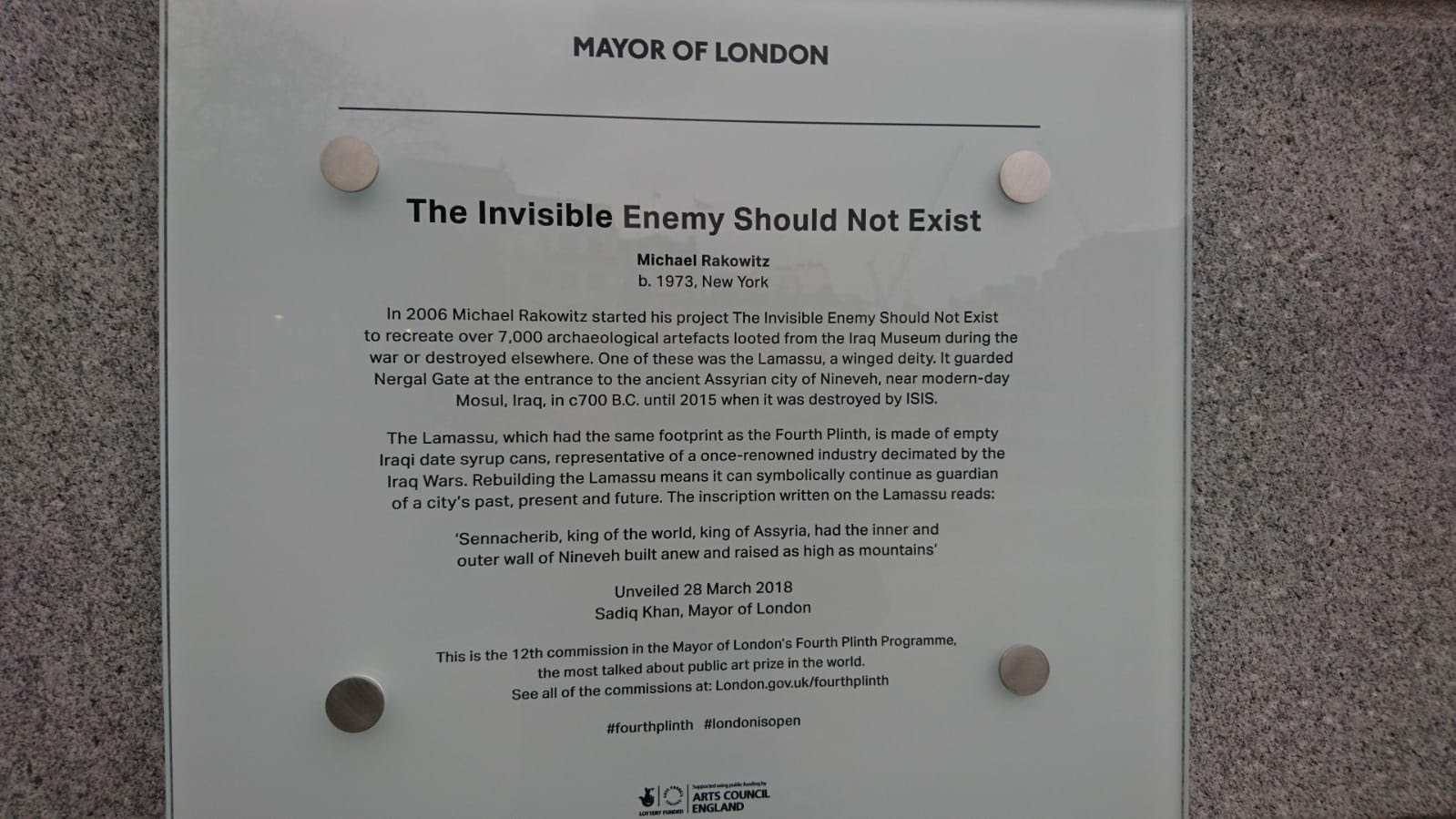
The Invisible Enemy Should Not Exist di Michael Rakowitz a Trafalgar Square

 Foto del reporter Michele Sisto

Un'opera tutta di lattine si erge ora sul quarto plinto di Trafalgar Square a Londra, si tratta del nuovo lavoro di Michael Rakowitz realizzato per questa storica manifestazione, che da ogni anno presente un lavoro contemporaneo sul quarto plinto della famosa piazza londinese.

Questo lavoro è stato realizzato con le lattine che erano prodotte in Iraq per la produzione di sciroppi di datteri, attività fiorente prima della guerra

  Foto del reporter Michele Sisto

  Foto del reporter Michele Sisto

  Foto del reporter Michele Sisto


CS

This year’s artwork is 'The Invisible Enemy Should Not Exist' by Michael Rakowitz.

Michael started The Invisible Enemy Should Not Exist project in 2006. It attempts to recreate more than 7,000 objects which have been lost forever. Some were looted from the Iraq Museum in 2003, while others were destroyed at archaeological sites across the country during the Iraq War.
For the Fourth Plinth, Rakowitz has recreated the Lamassu. This winged bull and protective deity guarded the entrance to Nergal Gate of Nineveh (near modern day Mosul) from c700 BC until it was destroyed by Daesh in 2015.
The reconstructions in The Invisible Enemy project are made from recycled packaging from Middle Eastern foodstuffs. The Lamassu is made from 10,500 empty Iraqi date syrup cans. This represents a once-renowned industry now decimated by war.
The inscription is written in Cuneiform, one of the earliest systems of writing, on the side of the Lamassu reads: “Sennacherib, king of the world, king of Assyria, had the inner and outer wall of Ninevah built anew and raised as high as mountains.”
Rebuilding the Lamassu in Trafalgar Square means it can continue to guard the people who live, visit and work in London. It is the 12th work to appear on the Fourth Plinth since the programme started, and will be there until March 2020.
To coincide with the unveiling, a pop-up event space and cultural hub curated by publisher Plinth was presented at Trafalgar Square, 28 March 2018.
A new range of products from design company Plinth and the Mayor of London to accompany the work will be available to purchase at the pop-up event. They are inspired by the use of food in Rakowitz’s art as a way of bridging cultural and political divides. The range includes tote bags, wooden spoons and aprons, and feature the Arabic proverb: A House With A Date Palm Will Never Starve.
A portion of the profits from the merchandise sales will go towards supporting the Mayor of London’s educational projects.


  Foto del reporter Michele Sisto


 Foto del reporter Michele Sisto


03/04/17

Prossimamente al Quarto Plinto


Sono Michael Rakowitz e Heather Phillipson i vincitori della selezione del Quarto Plinto a Trafalgar Square, nel cuore di Londra, le loro opere saranno istallate nel 2018 e nel 2020.


CS


Michael Rakowitz's 'The Invisible Enemy Should Not Exist' and Heather Phillipson's 'THE END' will be the next two works to appear on the Fourth Plinth and will be unveiled in 2018 and 2020 respectively.
They were chosen from a shortlist which included Huma Bhabha, Damián Ortega and Raqs Media Collective to win the commissions.
Rakowitz will recreate the Lamassu, a winged bull and protective deity that stood at the entrance to Nergal Gate of Nineveh from c 700 B.C.
In 2015 it was destroyed by ISIS along with other artefacts in Mosul Museum. The Lamassu will be made of empty Iraqi date syrup cans, representative of a once-renowned industry decimated by the Iraq Wars.
The Invisible Enemy Should Not Exist is a project begun by Michael Rakowitz in 2006 that attempts to recreate over 7,000 archeological artefacts looted from the Iraq Museum during the war or destroyed in its aftermath.
THE END by Heather Phillipson is a whirl of cream topped with a cherry and parasites.
There’s a cherry on the top, an enormous fly alighted on the side, and a whirling, illuminated contraption, which turns out to be a drone, sending out simultaneous video pictures of Trafalgar Square, which you can pick up on your mobile phone.
The work explores the extremes of shared experience, from commemorations and celebrations to mass protests, all while being observed by a drone’s camera. Topped with a giant, unstable load, the plinth becomes a monument to hubris and impending collapse.

05/02/17

Fourth Plinth 2018/2019


Due dei cinque saranno selezionati per le prossime edizioni del Fourth Plinth a Londra, eccovi i bozzetti tra cui a fine Marzo saranno selezionati i vincitori, se volete potete andare a votare nella S.Martin in the Field Crypte.


This large and imposing figure is made from brown cork and white polystyrene. It is smeared with expressionistic, painterly marks. The pose and scale reflects a modern comic sci-fi movie, where legendary cities skylines become backdrops for CGI action figures.
Trafalgar Square is the setting for this strange, yet familiar superhero. But, the sculpture goes beyond comic book culture and pop art. The use of humble materials and being hand carved connects it to African art, Picasso, Rodin and other early 20th Century works.

Huma Bhabha was born in 1962 in Karachi, Pakistan. She lives and works in New York.
I like: Huma Bhabha - Untitled


Damián Ortega: High

Damian Ortega High Fourth Plinth Shortlist
Higher is a tall construction of a truck, oil cans, scaffold and ladders, it is playful and precarious, as though it might suddenly collapse. Our first response is alarm, before we realise we have been duped, the casual construction is contrived, the sculpture is safe and secure.
Public sculptures are often monumental so they can be seen from a distance. The human scale of Higher is in deliberate contrast to this. Its odd construction represents imbalance and fragility, a device frequently used by Ortega.

Damián Ortega was born in 1967 in Mexico City, where he lives and works.
I like: Damián Ortega - High
Heather Phillipson: The End


THE END represents exuberance and unease. Topped with a giant, unstable load, the plinth becomes a monument to over-confidence and impending collapse. The surrounding architecture of Trafalgar Square and its population are participants in a mis-scaled landscape, one that magnifies the banal, and our cohabitation with other lifeforms, to apocalyptic proportions.
Trafalgar Square sees extremes of shared experience, from commemorations and celebrations to mass protests. This sculpture attempts to address the physical context of the square, whilst considering a broader ideological one.

Heather Phillipson was born in 1978 in London, where she lives and works.
I like: Heather Phillipson - The End


Michael Rakowitz: The Invisible Enemy Should not Exist

Michael Rakowitz The Invisible Enemy Should not Exist Fourth Plinth Shortlist
The Fourth Plinth is roughly 14 feet high. That’s the same size as the Lamassu, a winged bull and protective deity that stood at the entrance to Nergal Gate of Nineveh from c 700 B.C. In 2015 it was destroyed by ISIS along with other artefacts in Mosul Museum. The Lamassu will be made of empty Iraqi date syrup cans, representative of a once-renowned industry decimated by the Iraq Wars.
Rebuilding the Lamassu in Trafalgar Square means the sculpture can carry on as a guardian of Nineveh’s past, present and future, even as a refugee or ghost, hoping one day to return to Iraq.

Michael Rakowitz was born in New York in 1973. He lives and works in Chicago.
I like: Michael Rakowitz -The Invisible Enemy Should not Exist


Raqs Media Collective: The Emperor’s Old Clothes


The Emperor’s Old Clothes uses sculpture to look at how power can be both present and absent in sculpture.
The artists invoke a statue, a stony relic of the British Empire, only to take away the body of power from this figure, leaving just an empty robe as a remainder. The robe, empty of the figure it clothed, is like the royalty left behind by an emperor who went out in search of new clothes in Delhi. What remains on the plinth in London are the emperor’s old clothes, a ghost of the past and a warning for the future.

Spaces like Trafalgar Square encourage us to look to those who have wielded power. But being there is not just about considering the relics of powerful men. It is also a place that thousands of ordinary men visit, where they meet each other and pass the time.

Raqs (pronounced Rux) Media Collective was founded in 1992 by Jeebesh Bagchi, Monica Narula and Shuddhabrata Sengupta.

02/10/16

David Shrigley in Trafalgar Square sul Fourth Plinth


Da alcuni giorni in Trafalgar Square a Londra svetta sul Fourth Plinth la divertente scultura di David Shrigley.


Un intervento che sta suscitando pareri contrastanti, essendo un'opera temporanea, la trovo divertente e un poco ottimista.